
Women in the Workplace Scorecard Insights
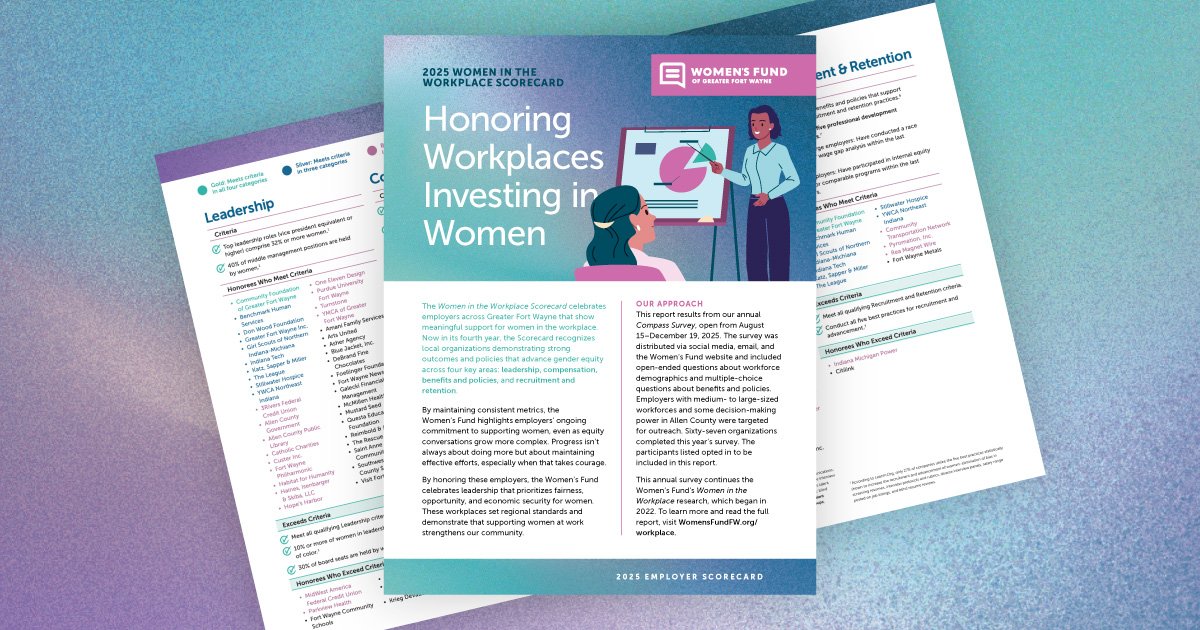
Each year, the Women in the Workplace Scorecard gives us a clearer picture of what it’s like to be a woman working outside the home in Allen County. It highlights progress worth celebrating and, just as importantly, reveals where work still needs to be done.
The 2025 results reveal a familiar but important story: Employers are actively involved in this work, but significant, consistent progress remains uneven.
One of the most encouraging trends is increased participation. A growing number of employers now report offering some form of paid leave and flexible work options. This support is vital in a community where women still bear the majority of caregiving responsibilities.
In fact, broader local data shows that women in Allen County continue to earn about 80 cents for every dollar earned by men and are more likely to leave the workforce or cut back on hours due to caregiving needs. Policies that address these realities are not perks. They are a necessary infrastructure for retaining talent.
The data also shows that representation, especially in leadership roles, continues to fall behind. Although women make up a large part of the workforce, that representation narrows at each step up the ladder. Both nationally and locally, women hold only about one-third of senior leadership positions, and our Scorecard reflects this same pattern. This isn’t just a pipeline issue; it’s a progression issue. It indicates that hiring women is not enough—organizations must also be intentional about promotion paths, leadership growth, and succession planning.
Compensation is another area where progress remains slow. Although more employers recognize pay equity as a priority, far fewer are conducting regular pay analyses or implementing transparent compensation structures. Without these practices, disparities can go unnoticed. Pay equity continues to be one of the most visible—and most addressable—indicators of workplace fairness.
Perhaps the most important takeaway from this year’s Scorecard is this: There is no one-size-fits-all solution. The employers who are making progress are those taking a comprehensive approach: examining hiring, retention, advancement, policies, and culture collectively, rather than separately.
We heard a powerful example of this at the Women in the Workplace Luncheon. Stillwater Hospice shared that they reduced their first-year employee turnover from 60% to 6%—not through a singular policy change, but by taking a holistic look at their workplace practices and culture. That kind of transformation doesn’t happen by accident. It happens when organizations commit to understanding their data, listening to their employees, and making sustained, strategic changes.
And that’s where the opportunity lies.
The Scorecard is not meant to be a benchmark you either meet or miss. It’s a tool. A starting point. A way to understand where you are today so you can make informed decisions about where to go next.
So, what comes next?
First, engage with your data. If you participated in the survey, take time to truly understand your results. Where are you leading? Where are you lagging? What patterns stand out?
Second, choose one or two areas to focus on this year. Progress doesn’t require doing everything at once, but it does require doing something with intention. Whether it’s conducting a pay analysis, formalizing promotion pathways, or expanding benefits, small, strategic steps can lead to meaningful change.
Third, don’t do this work in isolation. One of the most powerful aspects of this initiative is the growing network of employers committed to learning from one another. Sign up for our Lunch and Learn events, share what’s working, ask questions, and be part of a community that is actively trying to move the needle.
At the Women’s Fund, we remain committed to supporting you in that work—through data, resources, and partnerships that help turn insight into action.
Because ultimately, this isn’t just about individual organizations. It’s about the kind of community we are building together.
The data makes one thing clear: We’re moving what matters, but we’re not there yet.